A Review of the World Maps in This Chapter Indicates That in South America
6.1 Introducing the Realm
Learning Objectives
- Summarize the main physical features and characteristics of South America.
- Explicate how European colonialism dominated the realm and divided upwardly the continent.
- Describe the ethnic, economic, and political patterns in the Guianas.
- Outline the chief cultural realms of Southward America. Depict each realm's main ethnic majority and explain how colonialism impacted each region.
- Summarize how the South American countries are attempting to integrate their economies.
The continent of South America has a wide diversity of concrete landscapes, from the high Andes Mountains to the tropical forests of the Amazon Basin. This assortment of physical features offers many resource bases, assuasive people to appoint in economic activity, gain wealth, and provide for their needs. The long range of the Andes holds mineral riches that have been beingness extracted since ancient times. Precious metals have been mined from the mountains to grant great opportunities for those fortunate enough to exist recipients of its wealth. Fossil fuels take been establish in affluence in the far northern regions of Venezuela and Colombia. The Amazon Bowl has been a source of hardwood lumber and, more than recently, extensive mineral wealth. Some of the largest iron-ore mines in the world are located here. The massive plains of Brazil and the rich soils of the Pampas allow for enormous agronomical operations that provide food products for the continent and for the globe. Fifty-fifty the inhospitable Atacama region in northern Chile holds some of the globe's largest copper reserves. In improver, the wide variety of climate zones allows a various range of species to develop. The extremes in physical geography in South America have created both barriers and opportunities to those who live in that location.
Before the era of European colonialism, many local groups organized themselves into states or empires. The Inca Empire was the largest in existence at the fourth dimension the Europeans arrived. The early empires adult massive structures that required huge cut stones weighing many tons to be moved into place without the benefit of modern tools or technology. European colonialism contradistinct the continent in several ways. Not but did the Europeans defeat and conquer ethnic Amerindian groups such as the Inca, but cultural exchanges also took place that altered the way of life for countless South Americans. Colonialism created many of the current country borders and influenced merchandise relationships with the newly created colonies. The plantation system and the introduction of slaves from Africa drastically changed the ethnic makeup of the people living along the eastern coast. After slavery was abolished, indentured servitude brought workers from Asia to support the labor base.
Indentured servants were usually poor individuals who agreed to piece of work for an agreed upon menses of time, usually less than seven years, in return for the necessities of life such as lodging, food, and transportation or habiliment. These individuals did not usually receive a salary just may have received a lump sum payment upon completion of the agreed upon service. Under favorable weather condition indentured servants were treated like relatives and gained important experience and job skills to provide for their future. Many situations were much less favorable and resembled a form of slavery where individuals did not survive their servitude but succumbed to disease, harsh conditions, or expiry.
The physical surroundings and the influence of colonialism were both responsible for the cultural attributes of the regions of S America. The continent can be divided into regions past ethnic majorities influenced by early colonial development. The mixing of ethnic groups from Europe, Africa, and Asia with each other or with the indigenous population has created a various cultural mosaic. For example, most people in Guyana and Suriname are from Asia, about people in Argentina and Uruguay are from Europe, nigh people in Peru and Republic of bolivia are Amerindian, and near people in many areas along the eastern coast of Brazil are of African descent. A large percentage of the population of Due south America is of a mixed indigenous background. Understanding the cultural geography of South American supports comprehension of the realm's human evolution patterns.
South America's modern economic evolution has helped integrated information technology with the global economy. The levels of economical development vary widely within the realm. There are clear indications of core-peripheral spatial patterns inside various regions of the continent, and rural-to-urban shift has been strong in many areas. The rural regions in the Andes or the interior suffer from a lack of economic support needed to modernize their infrastructure. At the same time, metropolitan areas are expanding speedily and are totally integrated with global markets and the latest technologies. Most of the big cities are located along the coastal regions. This blueprint of urbanization is mainly a consequence of colonial activity and influence. The countries of South America are working amidst themselves to network trade and commerce activities. Trade agreements and economical unions take get standard methods of securing business partnerships to heighten the realm's economic opportunities.
Concrete Geography
The far-reaching Andes Mountains and the massive Amazon River system dominate Southward America'due south concrete geography. The 5-one thousand-mile-long Andes Mountain chain extends along the entire western region of the continent from Venezuela to southern Chile. The Andes are the longest mountain chain on Earth and the highest in the Americas. The Andes Mountain range has more than than thirty peaks that accomplish at least twenty chiliad feet in summit, many of which are agile volcanoes. The Andes has provided isolation to the Inca Empire, mineral wealth to those with the means for extraction, and a barrier to travelers crossing the continent. The Andes' minerals include gold, silver, can, and other precious metals. Mining became a major industry in the colonial era and continues to the present.
At the core of the continent is the mighty Amazon River, which is more than than two thousand miles long and has an enormous drainage basin in the largest tropical rain forest in the earth. The Amazon's many tributaries are larger than many other globe rivers. Flowing parallel to the equator, the Amazon is in contention with the Nile as the longest river in the world. In 2007, a dispute arose over the bodily length of the Amazon River. Brazilian scientists using satellite imagery and teams on the basis using a global positioning arrangement (GPS) calculated a new length for the Amazon. Using similar methods, the Nile River also had a new length calculated. Both were determined to be longer than originally measured. At this fourth dimension, the bodily length of each river is openly disputed. The most accurate statement is that the Amazon River has the greatest discharge of any river in the world, and it is potentially too the longest river in the world.
The Amazon carries near a fifth of all river h2o in the world. The Amazon and its many tributaries drain the entire interior region of the continent, covering twoscore percentage of South America. During the rainy season, the Amazon River tin can exist more than one hundred miles wide. No bridges span the Amazon River. Its source is a glacial stream located high in the Peruvian Andes, about 150 miles from the Pacific Body of water.
The Amazon's extended tributaries—such as the Rio Negro, the Madeira, and the Xingu—movement massive amounts of water through the Amazon Basin and are major rivers in their own right. The Amazon has more than than 1,100 tributaries; a dozen are more than one thousand miles long. Hydroelectric dams are located on the tributaries to produce electricity for the region's fast-growing development. South America has additional large rivers that drain the continent, including the Orinoco, which flows through Venezuela; the Sao Francisco, which flows through southeast Brazil; and the Paraguay and the Paraná Rivers, which flow south from Brazil into the Rio de la Plata between Argentina and Uruguay.
Lake Titicaca rests in the eye of the Altiplano Region of the Central Andes on the border between Peru and Bolivia. The Altiplano Region is a wide basin betwixt two main Andean mountain ranges. The word altiplano ways "valley" in Spanish. In that location are a substantial number of altiplanos in South America. They provide for agronomical production and man habitation. The Altiplano Region has been home to ancient civilizations that date back to early human being settlements. Lake Titicaca is a large freshwater lake virtually 120 miles long and 50 miles wide. The surface is at an acme of nearly twelve yard anxiety in a higher place sea level, and the lake is more 9 hundred feet deep in some areas. Usually at such loftier elevations, the temperature would dip beneath freezing and restrict agronomics. However, the large lake acts every bit a solar energy collector by absorbing free energy from the sun during the 24-hour interval and giving off that energy in the form of oestrus during the night. The free energy redistribution allows for a moderate temperature around the lake that is conducive to growing food crops. With arable fresh h2o and the ability to grow food and grab fish, the Altiplano Region has supported human being habitation for thousands of years. On the Bolivian side of the lake is the aboriginal stone site of Tiahuanaco, which has had some artifacts dated to 1500 BCE or before. People continue to live around and on Lake Titicaca and maintain a subsistence lifestyle.
Figure 6.ii Lake Titicaca with Traditional Reed Boat Made by Amerindian Locals
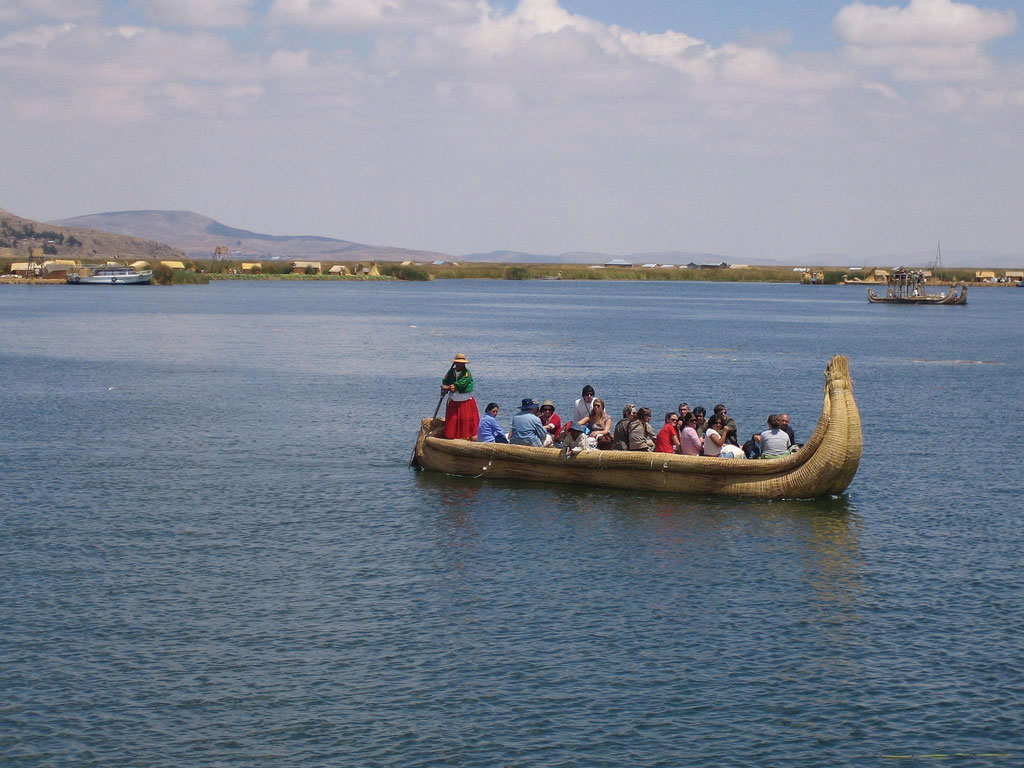
Lake Titicaca is the highest-meridian navigable lake in the world.
Benedict Adam – Republic of peru – CC Past two.0.
Beyond the Andes Mountains from the Altiplano Region is the Atacama Desert. The Atacama is one of the driest places on World: in some parts, no rain has fallen in recorded history. In normal circumstances, the Atacama would be a desolate region without human activity, but that is not the example. Some of the earth's largest copper reserves are found here. Nitrates, which are used in fertilizers, are also found in large quantities. Mining the Atacama has brought enormous wealth to people fortunate plenty to be on the receiving finish of the profits. The rain shadow issue is responsible for the extraordinary dryness of the Atacama. The Andes are quite loftier at this latitude, and the winds accident in rain clouds from the east. When the clouds achieve the mountains, they ascend in height, releasing their atmospheric precipitation without e'er reaching the western side of the Andes.
South America has big agronomical plateaus eastward of the Andes, such as the Mato Grosso Plateau, which includes a portion of the bully cerrado agronomical region of key Brazil. The Cerrado is a vast plain that has been developed for agriculture and produces enormous harvests of soybeans and grain crops. Adjoining the Cerrado to the southeast are the Brazilian Highlands, an all-encompassing coffee-growing region. The Pampas in eastern Argentina, Uruguay, and southernmost Brazil is some other excellent agricultural region with good soils and adequate rainfall. Farming, cattle ranching, and even vineyards can be found here, making the Pampas the breadbasket of the Southern Cone. To the s of the Pampas is the lengthy expanse of Patagonia, which covers the southern portion of Argentina east of the Andes. Patagonia is a prairie grassland region that does not receive a very much rainfall because of the rain shadow effect of the Andes to the west. The chief activities in Patagonia are the raising of cattle and other livestock. The region is starting to concenter attention for the extraction of natural resources such equally oil, natural gas, and valuable minerals.
To the northern role of the continent in Venezuela and Republic of colombia, sandwiched between the Andes Mountains and the Guiana Highlands, is a grassland region with scrub forests called the Llanos. The human population is small because of the remoteness of the region along the Orinoco River basin. The Guiana Highlands of southeast Venezuela and the Guianas are an isolated set of mountainous plateaus mixed with rugged landscapes and tropical climates. Angel Falls, the highest waterfall in the globe, with a gratuitous fall of more than two,647 feet and a total drop of about three,212 feet (more than half a mile), is located here. To the northwest of the Llanos and the Guiana Highlands in Venezuela is Lake Maracaibo, a big inland lake open to the Caribbean Sea. A littoral lake, Maracaibo rests atop vast oil reserves that provide economic wealth for Venezuela.
European Colonialism
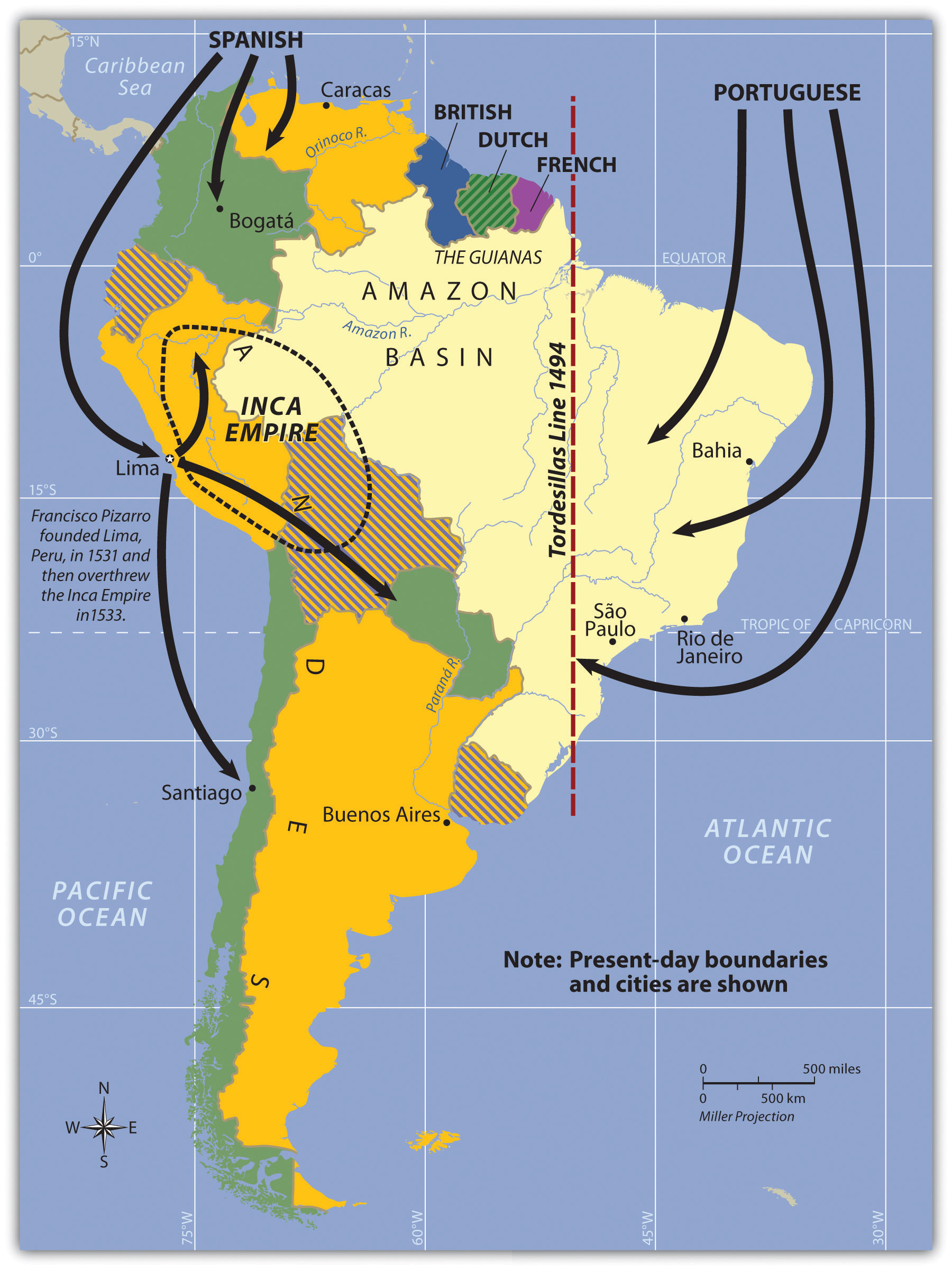
S America's colonial legacy shaped its early cultural landscape. The ethnic people, with their empires and local groups, were no match for the Iberian invaders who brought European colonialism to the continent. South America was colonized exclusively past ii principal Iberian powers: Spain colonized the western office of the South America, and Portugal colonized the east coast of what is present-day Brazil. The only region that was non colonized past those two powers was the modest region of the Guianas, which was colonized by Groovy United kingdom of great britain and northern ireland, the Netherlands, and France.
Figure 6.3 Colonial Activity in Southward America
Everything changed with the invasion of the Iberian colonizers. The underlying tenets of culture, religion, and economics of the local indigenous people were disrupted and forced to change. It is no mystery why the 2 dominant languages of South America are Spanish and Portuguese and why Roman Catholicism is the realm's dominant religion. Colonialism also was responsible for transporting food crops such equally the potato, which originated in the Peruvian Andes, to the European dinner table. Today, java is a main export of Colombia, Brazil, and other countries in the tropics. Coffee was not native to Due south America but originated in Ethiopia and was transferred by colonial activity. The same is true of sugarcane, bananas, and citrus fruits; oranges were non native to S America, just today Brazil is the number one exporter of orange juice. Colonialism was driven past the desire for profit from the quick sale of products such as golden or silver, and at that place was a ready market for goods not institute in Europe, such equally tobacco, corn, exotic animals, and tropical woods.
Plantation agriculture introduced past the Europeans led to a high demand for manual laborers. When the local populations could not meet the labor demand, millions of African workers were brought through the slave merchandise. These African slaves introduced their own unique community and traditions, altering the culture and demographics of the Western Hemisphere. The electric current indigenous Amerindian population, a fraction of what it was before the Europeans arrived, makes up merely a small percentage of South America's total population. Europeans colonizers generally took the all-time land and controlled the economic trade of the region. The acculturation in South America is directly related to the European colonial experience.
The Inca Empire and Francisco Pizarro
Not long after Hernán Cortés conquered the Aztec Empire of United mexican states in 1521, a immature Spanish conquistador named Francisco Pizarro, stationed in what is now Panama, heard rumors of silver and gold found among the Southward American people. He led several sailing excursions along the west coast of South America. In 1531 CE, he founded the port metropolis of Lima, Republic of peru. Since 1200 CE, the Inca had ruled a large empire extending out from central Peru, which included the high-elevation Altiplano Region around Lake Titicaca. The Inca Empire dominated an area from Ecuador to Northern Chile. The Inca were not the nigh populous people but were a ruling course who controlled other subjugated groups. Pizarro, with fewer than ii hundred men and 2 dozen horses, met upwards with the Inca armies and managed to defeat them in a series of armed forces maneuvers. The Inca leader was captured past the Castilian in 1533. Two years subsequently, in 1535, the Inca Empire collapsed.
Figure vi.4 Colonialism in S America
The two main colonizers in South America were Kingdom of spain and Portugal. The Castilian conqueror Francisco Pizarro defeated the Inca Empire.
The Inca Empire was significant thanks to the loftier volume of gold and silver found in that region of the Andes. The story is told that Pizarro placed the captured Inca leader in a pocket-size room and told him that if the room was filled with gold to the peak of the Inca leader's head, Pizarro would let the Inca leader become free. Gold was summoned from the people and the countryside, and the room was filled. The conquistadors forced the Inca leader to convert to Catholicism and be baptized and so killed him. The gold was melted down and transported back to Espana. The mineral wealth of the Andes made the conquistadors rich. Lima was once one of the wealthiest cities in the world. Europeans connected to dominate and exploit the mining of minerals in Peru and Bolivia throughout the colonial era. European elites or a Mestizo ruling class has dominated or controlled the local Amerindian groups in the Andes since colonial times.
Effigy 6.v The Jesuit Church of La Compañia de Jesús on the Plaza de Armas in Cuzco, Peru
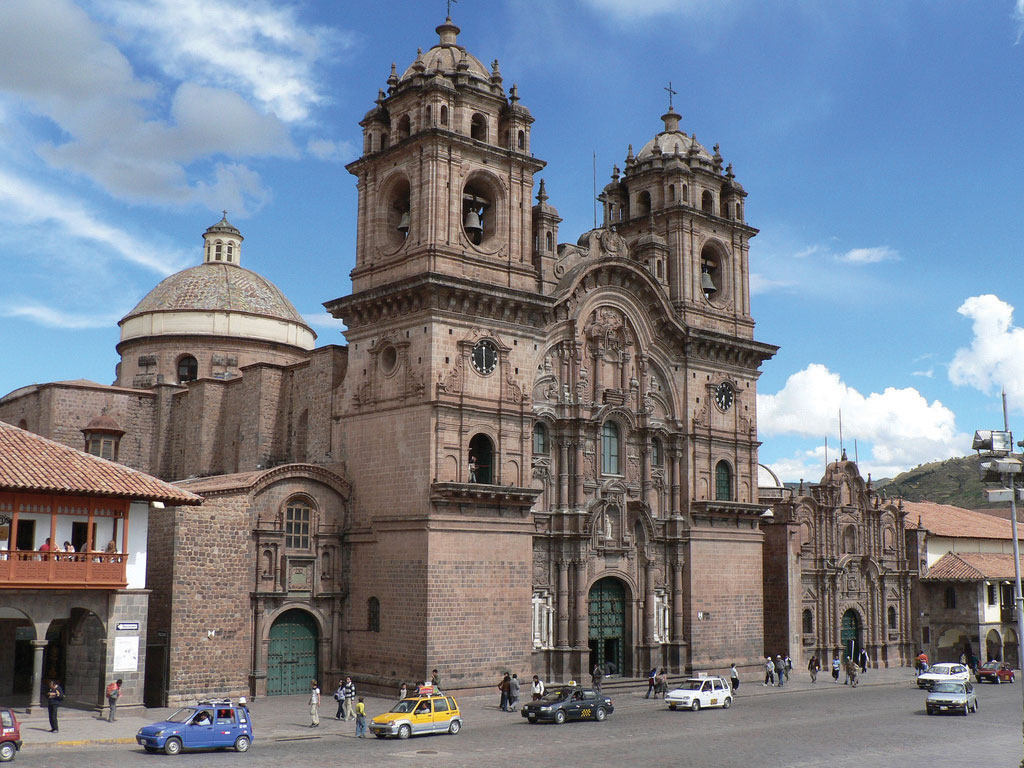
The original church building was constructed in 1571 on the site of the ancient Incan palace. The earthquake of 1650 acquired severe harm to the building, so it had to be reconstructed in about 1688. Many Cosmic cathedrals in Latin America were built with stones from aboriginal sites. This cathedral is claimed to be the Western Hemisphere's almost ideal example of colonial baroque architecture.
Many Amerindian groups inhabited this region before the Inca Empire, such every bit the people who built and lived in the ancient city of Tiahuanaco, which could have bordered Lake Titicaca during an earlier climate menses, when the lake was much larger. Clearly, humans have lived in Southward America for thousands of years. There is speculation that travel between South America and the Mediterranean region occurred earlier than current celebrated records signal. Many of the ruins in the western region of South America have not been thoroughly excavated or examined by archaeologists, and the size and scope of many of the stone structures stand up as testimony to the advancements in engineering and engineering employed in an era that, according to historical records, had merely primitive tools.
The Iberian Segmentation of the Continent
The Castilian conquistadors were not the but European invaders to colonize South America. Colonial influence—which forced a change in languages, religion, and economics—also came from the small European kingdom of Portugal. Portuguese ships sailed along the eastern coast of South America and laid claim to the region for the king. The Portuguese did not find large gold or silvery reserves, but they coveted the land for the expansion of their empire. Soon the Spanish and the Portuguese were fighting over the same parts of Southward America. In 1494, the upshot was brought before the Roman Catholic Church. The Tordesillas Line was drawn on a map to divide Due south America into the Spanish west and the Portuguese east. The region that is now Brazil became the largest Portuguese colonial possession in South America, a center for plantation agriculture similar to that in the Caribbean. For this reason, a large African population lives in Brazil, and most of the people in Brazil speak Portuguese and are Roman Catholics.
Independence did non come up for the Castilian colonies until 1816 and 1818, when Chile and Argentina broke away in an independence movement in the south. Simón Bolívar led liberation movements in the north. Past 1824, the Spanish were defeated in South America. Brazil did not gain independence from Portugal until 1822, when the prince of Portugal declared an contained Brazil and made himself Brazil's get-go emperor. Information technology was not until 1889 that a true democracy was declared and empire was abolished.
Colonialism and the Guianas
The Guianas in the northeast were the just European colonies in South America that were not under Spanish or Portuguese command. The British, Dutch, and French all held claims to unlike parts of the Guianas. French Guiana remains a colony (department) of French republic to this twenty-four hours. The transition from colony to contained state has required persistence, time, and patience. Guyana and Suriname only just received their independence in the latter function of the twentieth century.
Effigy 6.6 The Guianas of South America
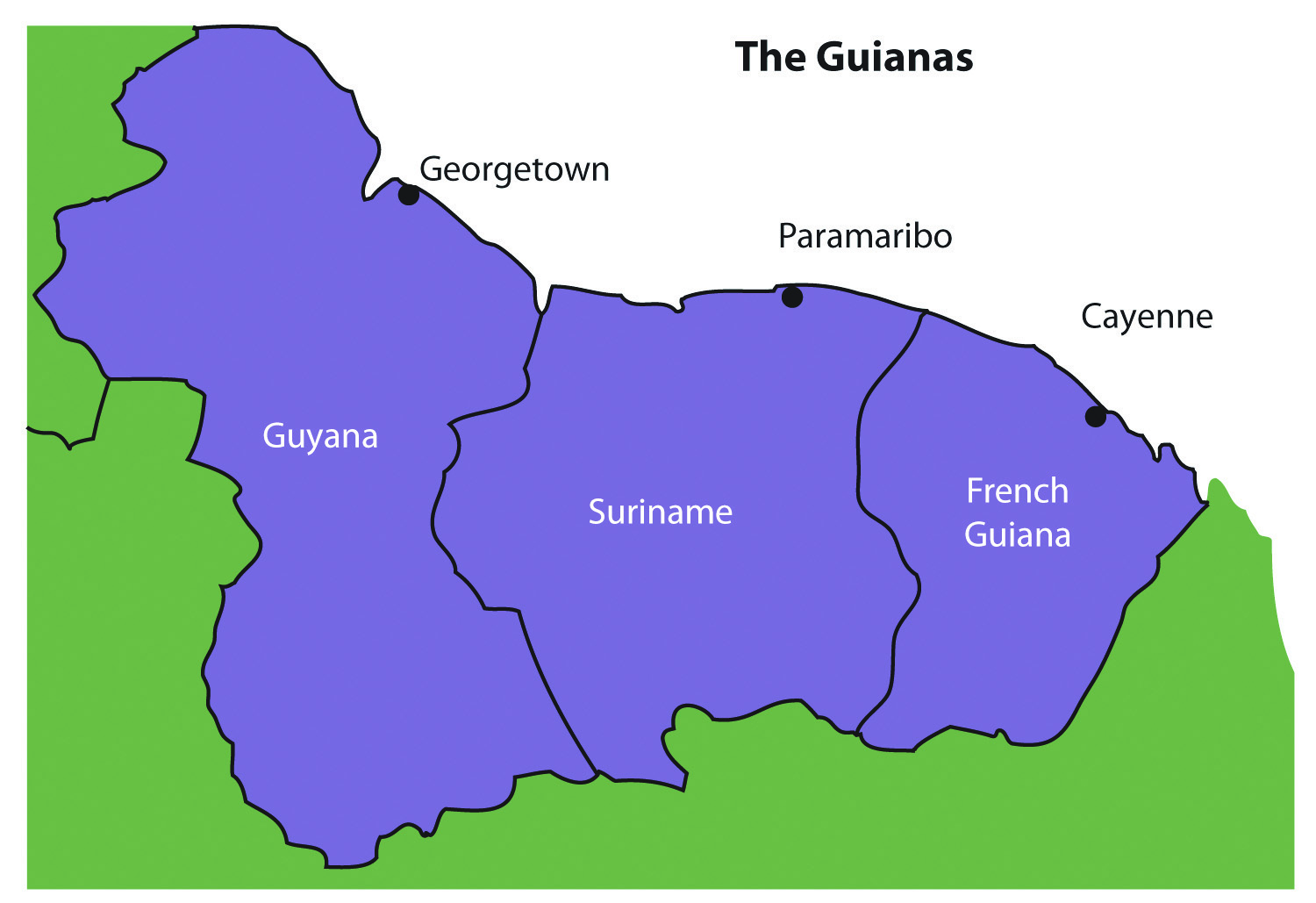
The coastal location of the Guianas provided European colonialists with an excellent site for plantation agriculture. Coastal cities had easy access to the Atlantic trade arrangement. The active slave trade in the Atlantic brought African slaves to the Guianas to work the plantations. When slavery was abolished, indentured servants were brought in from other parts of the globe that were colonized by the same European powers. Colonialism and plantation agriculture entirely changed the cultural dynamics of the Guianas. Port cities forth the declension are the dominant urban centers. The Guianas follow a design like to that of the rimland of the Caribbean area and are included with the Caribbean area in many studies. At the present fourth dimension, bauxite (aluminum ore) mining and oil deposits along the declension provide pocket-sized income, and many people make their living in subsistence agriculture.
Guyana
Guyana and its neighbors take a tropical type A climate. The main interior regions are covered with dense forests. Some deforestation has taken place in Guyana; even so, forests cover more than than fourscore percent of Republic of guyana's state expanse with a diverse range of forests, ranging from dry evergreen forests to tropical pelting forests, and with thousands of species of plants that are only found in this region. Guyana'south natural habitats and biodiversity are unparalleled, which is attributable to the climate, distinctive landforms, and largely well-preserved ecosystems. Its large rain forests play host to a myriad of species not constitute elsewhere. The interior regions remain more than than 70 per centum pristine, just this will change if logging, mining, and deforestation are not managed appropriately.
Guyana was chosen British Guiana before it became independent in 1966. The region was domicile to Carib and Arawak groups earlier the arrival of the Dutch, who established the first colony there in 1616. By 1831, the British had taken control and declared the colony British Guiana. African slaves were the main source of plantation labor until slavery was abolished in 1834. At that point, indentured servants from many countries were targeted for labor; nigh were East Indians from South asia. There were as well thousands of servants from Cathay and other countries.
The ethnic background of Republic of guyana's population, which is less than i million, is a mix of African (36 percent), East Indian (l per centum), and Amerindian (vii percent). The residual are mixed and European. The religious background of the East Indians includes both Hindus and Muslims. Virtually 50 percent of the population has converted to Christianity. Indigenous divisions create difficulties in organizing politics and social activities. For example, 1 political concern is that minority groups with greater economical advantages will dominate the political arena without regard to the wishes of other indigenous groups.
Most of Guyana'due south people live in the coastal regions. The almost impenetrable interior has large uninhabited areas with dense tropical forests. To protect its unique biodiversity, large areas accept been placed in conservation areas and national parks. More than than one million acres have been placed in the Konashen Community-Endemic Conservation Area (COCA) to help preserve the natural environs and provide a sustainable economic human relationship with local Waiwai people. In a similar effort, the government created the Kaieteur National Park, which features the spectacular Kaieteur Falls, which is about five times higher than Niagara Falls in North America. For its size, the falls has an enormous amount of h2o volume flowing over its crest. Other areas of the Guyana are also being considered for preservation.
Figure half dozen.7 Kaieteur Falls, Guyana
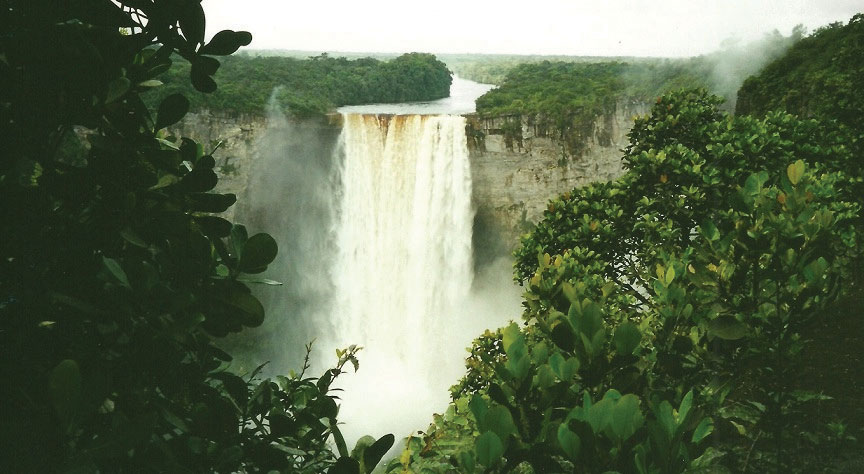
Kaieteur Falls has the largest single-drop waterfall by volume in the earth. A national park has been created in this expanse to include the falls.
Republic of guyana's economy is based on agricultural activities and the consign of extracted natural resources. Sugarcane is a main cash crop, and timber sales are increasing. Fishing is common in the coastal areas. Bauxite mining has been the main mining activity, and mining of gold and other minerals has simply advanced in recent years. Guyana'south economy is similar to that of many islands of the Caribbean, a relationship exemplified past its membership in CARICOM (the Caribbean Community). CARICOM'due south headquarters is located in Georgetown, the capital letter of Guyana.
Suriname
Suriname's colonial proper name was Dutch Guiana. The name was changed when independence was granted in 1975. The cultural background of the colony is every bit diverse as its history. Dutch Guiana was divided betwixt British and Dutch colonists. Slavery and plantation agriculture were introduced in the colonial menstruum, and the harsh conditions of slavery acquired many slaves to escape the plantations and live in the forests. These runaway slaves, called Maroons, eventually organized into viable contained groups. Peace treaties were finally made with the Maroons to grant them legitimate rights. After slavery was abolished, indentured servants from South Asia and the Dutch East Indies (Indonesia) were conscripted into the colony's labor base of operations.
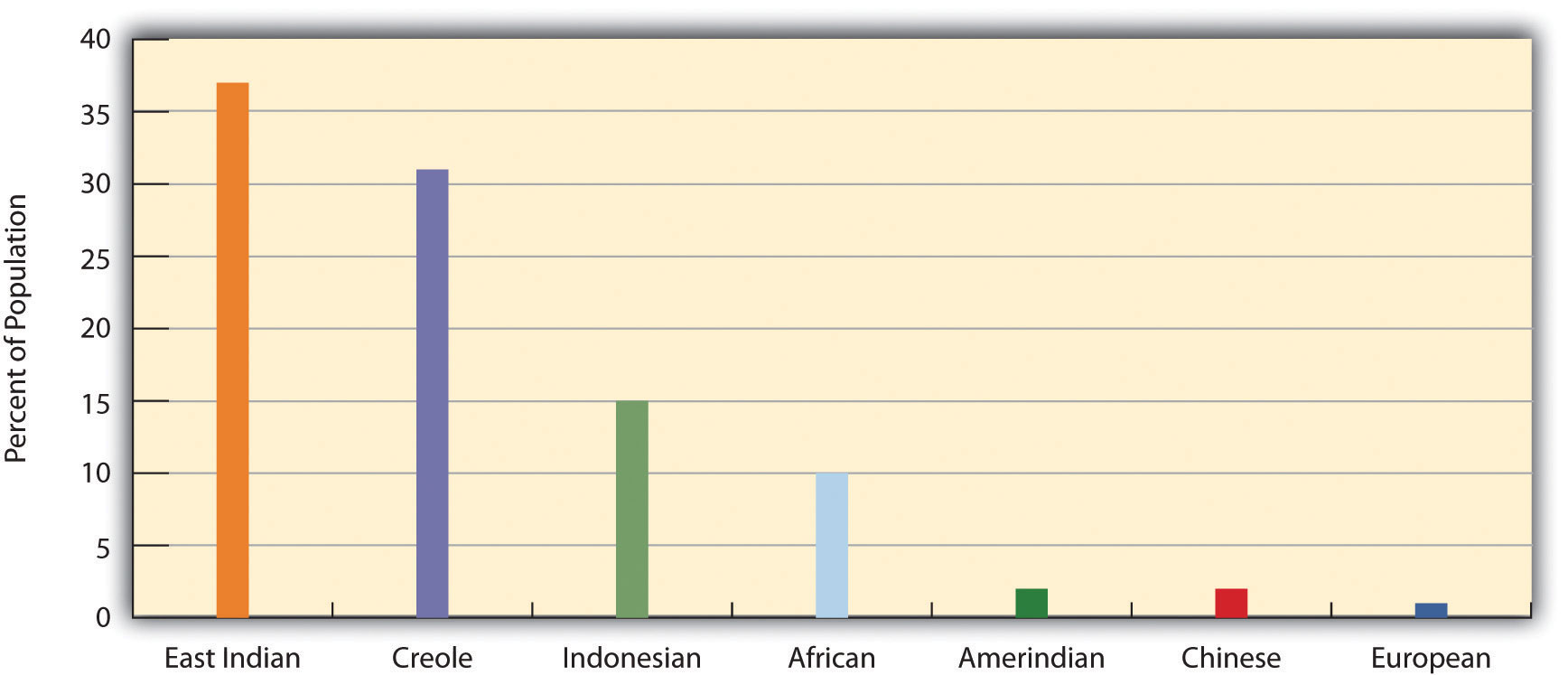
Most of the half-one thousand thousand people who live in Suriname today reside along the coast. The ethnic background of the people includes E Indian (37 percent), Creole (31 percent), Indonesian (15 percent), African (10 percent), Amerindian (2 percent), Chinese (two per centum), and European (well-nigh 1 percent). All three of the Guianas are ethnically diverse, and in this setting, the diversity creates tensions related to social and economic stability. Guyana and Suriname are the least Latin regions of S America; the Creoles, for example, are mainly a mix of African and Dutch mixed with Asian or Amerindian. Establishing a stable government and conducting civil affairs are often complicated by the ethnic groups that vie for power and political command. The religious background in Suriname includes Hindu, Muslim, Christian, and a mix of African religions such as Winti.
Effigy half dozen.8 Ethnic Groups of Suriname by Pct of the Population
Suriname depends on agriculture and natural resources as its two chief economic activities. Suriname has the smallest physical area of all the contained South American states, and information technology has a express ability to provide opportunities and advantages for its growing population. Bauxite is the state's main export product. In 1941, during Globe State of war 2, the United States occupied the country to secure the valuable bauxite mines that were critical to the war effort. Suriname has also been expanding its gold mining, oil extraction, logging, and fishing industries. To protect its natural environment and its all-encompassing biodiversity, the country has established national parks and created the large Primal Suriname Nature Reserve, which UNESCO has named a World Heritage Site. Suriname hopes to benefit from these measures to create an ecotourism marketplace.
Both Republic of guyana and Suriname have had border disputes with their neighbors. Republic of guyana has been locked in a challenge with Venezuela over its western region, which Venezuela claimed during the colonial era. A 1905 treaty ruled in Guyana's favor, but a minor portion is still under dispute. The corner of Surname that borders Brazil and Republic of guyana has been an issue of contention fueled by the potential for mining of gilded and other minerals in the expanse. The maritime boundary betwixt Suriname and Guyana is also a point of contention. Suriname's edge with French Guiana has a disputed expanse along the southern corner side by side to Brazil. These disputes emerged out of colonial agreements and poorly defined treaty boundaries.
French Guiana
French Guiana is yet a colony (department) of French republic. With fewer than 250,000 people in an area slightly smaller than Kentucky, this is a sparsely inhabited area. One-half the population lives in the capital city of Cayenne. Most of the population is Creole, mainly a combination of African and French with various Asian groups mixed in. The people work in subsistence agriculture or for the French government. A noted feature of the colony's heritage is the former off-shore prison house on Devil'southward Island, which France used to secure its most undesirable prisoners. More than than fifty one thousand French prisoners were delivered to the Devil'due south Island facility during the colonial era, but less than 10 percent survived. The prison was closed in 1951.
Figure 6.nine The Ariane 42P Carrying the TOPEX/Poseidon Spacecraft
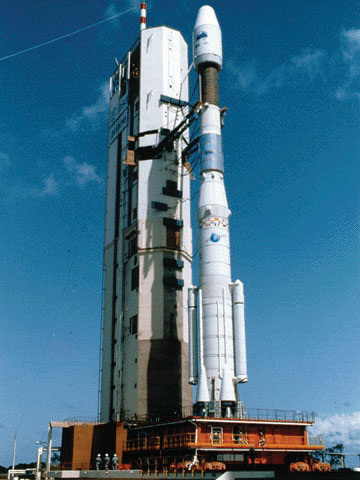
This Ariane 42P was launched from the European Space Agency's Guiana Space Middle in Kourou, French Guiana, on August 10, 1992.
Photo courtesy of NASA – public domain.
The European Infinite Agency maintains a launch centre in French Guiana considering of its favorable climate and launch weather. French republic maintains the facility and has highly subsidized the department's economic system. This European support provides the population with a higher standard of living than in many other South American countries. Economic activities take included fishing, agriculture (bananas and sugar), and logging. Deforestation from the auction of hardwood lumber has become a problem throughout the Guianas every bit it leaves the soil open up for erosion. Logging endangers the area's frail just all-encompassing biodiversity. Roads, dams, and golden mining have also contributed to the erosive destruction of the environment.
Cultural Regions of South America
It is impossible to empathise the current conditions in Due south America without first understanding what occurred to create those atmospheric condition. This is why studying European colonialism is so important. Colonialism changed the ethnicity, religion, linguistic communication, and economical activities of the people in South America. The past five hundred years have tempered, stretched, and molded the electric current states and regions of the South American continent. To identify standards of living, indigenous majorities, and economic conditions, it is helpful to map out South America's various cultural regions.
In South America, five main cultural regions indicate the bulk indigenous groups and the principal economic activities:
- Tropical Plantation Region
- Rural Amerindian Region
- Amazon Bowl
- Mixed Mestizo Region
- European Commercial Region (Southern Cone)
Figure 6.10 Cultural Spheres of South America.
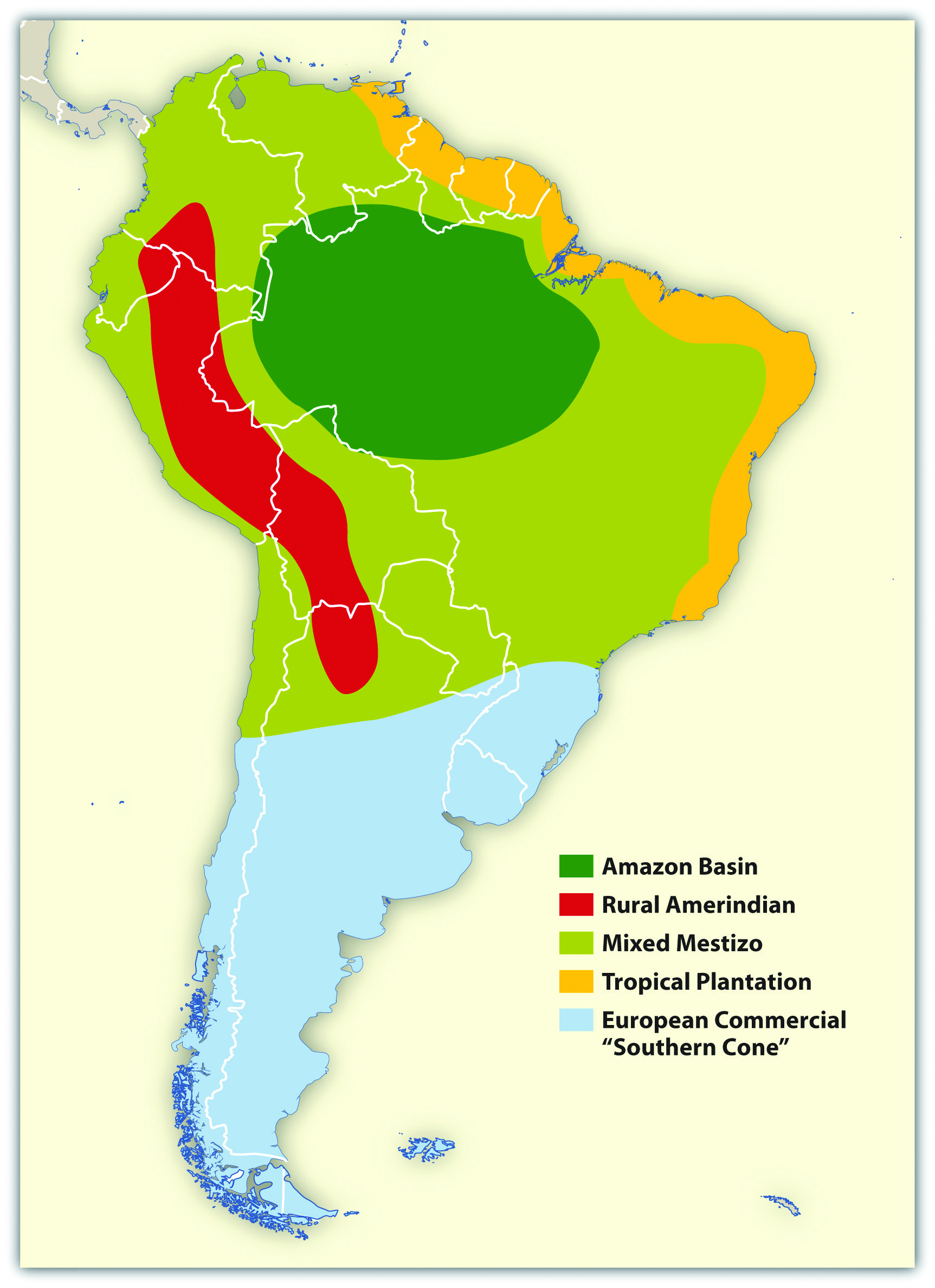
These are generalized regions that provide a basic understanding of the whole continent. Technological advancements and globalization take increased the integration of the continent to the bespeak that these regions are not equally delineated as they in one case were, merely they notwithstanding provide a context in which to cover the ethnic and cultural differences that exist within the realm.
Tropical Plantation Region
Effigy 6.11 Young Women in Salvador, Brazil
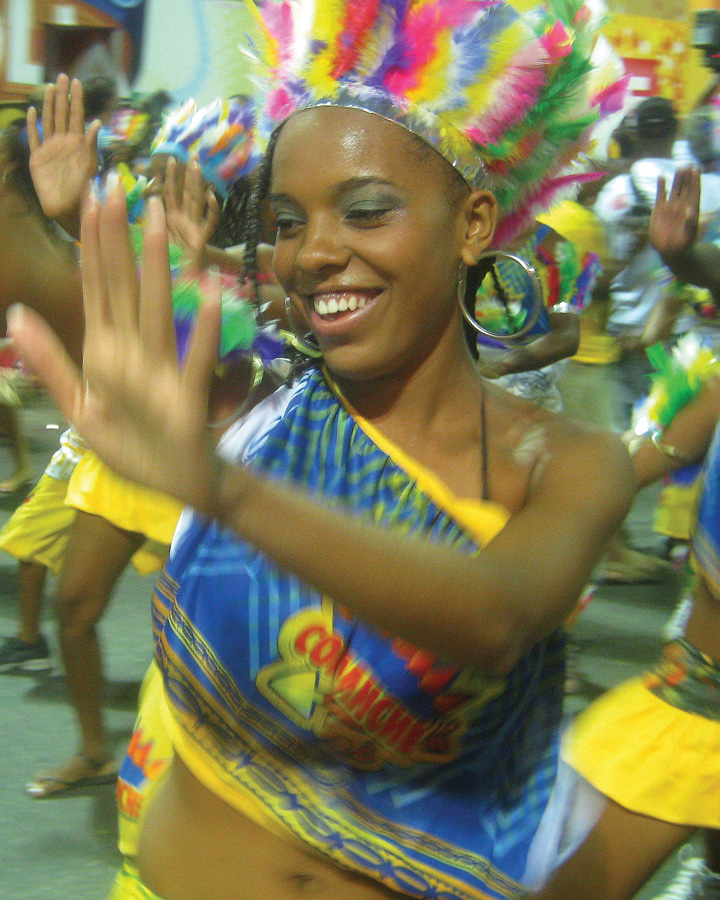
Salvador, Brazil, is located along the coastal region of South America where the Tropical Plantation Region was prominent. Most people in this region are of African descent.
Located along the north and east declension of South America, the Tropical Plantation Region resembles the Caribbean rimland in its culture and economical activity. The region, which extends as far south as the Tropic of Capricorn, has a tropical climate and an agricultural economy. Europeans opened up this area for plantation agriculture because of coastal admission for ships and trade. The local people were forced into slavery, but when the local people died off or escaped, millions of African slaves were brought in to supercede them. After slavery was abolished, indentured servants from Asia were brought to the Guianas to work the plantations. The Tropical Plantation Region has a high percentage of people of African or Asian descent.
Rural Amerindian Region
Figure 6.12 Amerindians
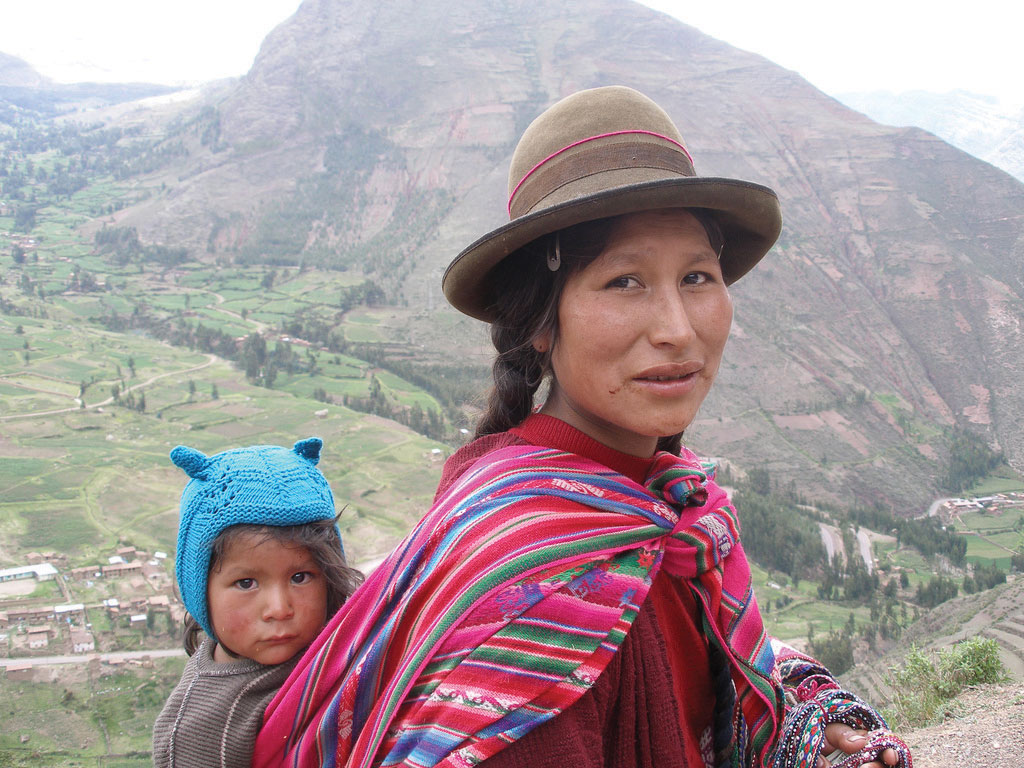
The Amerindian adult female and child in this photograph live in the Sacred Valley of the Andes in Peru.
The Rural Amerindian Region includes the countries of Republic of ecuador, Peru, and Republic of bolivia. The ruling Mestizo class that inherited control from the European conquistadors mainly lives in urban areas. Nigh of the rural Amerindian population lives in mountainous areas with type H climates and ekes out a difficult living in subsistence agriculture. This is 1 of the poorest regions of S America, and land and politics are controlled by powerful elites. The extraction of gold and argent has not benefited the local Amerindian majority, which holds to local community and speaks local languages.
Amazon Basin
The Amazon Basin, which is characterized past a type A climate, is the to the lowest degree-densely populated region of South America and is abode to isolated Amerindian groups. Evolution has encroached upon the region in the forms of deforestation, mining, and cattle ranching. Large deposits of iron ore, forth with aureate and other minerals, accept been found in the Amazon Basin. Preservation of the tropical rain forest of this remote region has been hampered by the destructive pattern of evolution that has pushed into the region. The future of the basin is unclear because of development patterns that are expected to continue every bit Brazil seeks to exploit its interior peripheral region. Conflicts over land claims and the autonomy of Amerindian groups are on the rise.
Figure 6.13 Amazon River Drainage Basin
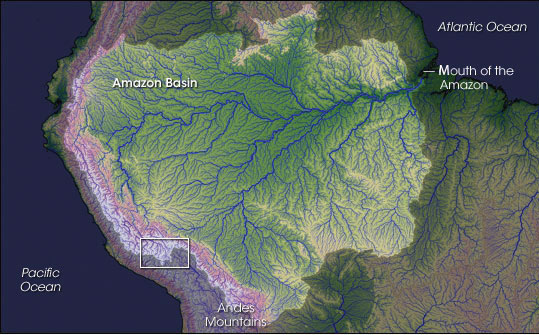
The Amazon has more than than 1,100 tributaries.
Epitome courtesy of NASA – public domain.
Mixed Mestizo Region
The Mixed Mestizo Region includes the coastal expanse of the west and the interior highlands of the north and east. This region betwixt the Tropical Plantation Region and the Rural Amerindian Region includes a majority of people who share a mixed European and Amerindian ethnicity. It is not as poor equally the Rural Amerindian Region and even so not every bit wealthy equally the European-dominated region to the south. Paraguay falls into the Mixed Mestizo Region, every bit do other portions of other S American countries such as parts of Brazil, Colombia, and Venezuela. Paraguay is mainly Mestizo, but its economic qualities resemble that of the Rural Amerindian Region to the north, fifty-fifty though Paraguay is not located in the mountains.
European Commercial Region (Southern Cone)
The southern part of South America, called the European Commercial Region or the Southern Cone, includes Republic of chile, Argentina, Uruguay, and parts of Brazil. European ethnic groups boss this region and include not only Spanish and Portuguese but besides German language, Austrian, Italian, and other European ethnic heritages. Fertile soils and European merchandise provided early on economic growth, and the region attracted manufacture and manufacturing in the later decades of the twentieth century. There are not many Amerindians or people of African descent hither. More 90 percent of all the people in Argentina, Republic of chile, and Uruguay are of European descent and live in urban areas. With a highly urbanized population and with trade connections to a globalized economy, it is no surprise that the Southern Cone is home to Southward America's well-nigh developed economies.
Globalization and Merchandise
Due south America has been fragmented past European colonialism, which established colonies and economic dependence on its European masters. The colonial economic patterns did not encourage the Due south American countries to work together to create an integrated continental trade network. Countries outside the continent have promoted trade partnerships to benefit from Southward America's natural resource and agronomical exports. The establishment of the European Spousal relationship and the Due north American Free Trade Agreement (NAFTA) created globalized trading blocs that challenged the S American countries to consider how to take advantage of trading opportunities inside their realm to protect and support their ain economical interests.
Since the 1990s, cooperation and business organization ventures have started to form within the realm to create a more integrated network of merchandise and commerce to do good the countries of South America. Transportation and advice systems are being adult through joint ventures by internal investment groups. River and road systems go along to be managed and developed for improved transport of people and goods throughout the continent. Free-trade agreements have been implemented to support the integration of internal economic networks and competition in the global marketplace.
In 2008, the Due south American countries formed the Marriage of South American Nations (UNASUR) to oversee the customs unions and merchandise agreements within the realm. One of the more established trade associations is Mercosur (the Southern Cone Common Market), created in 1995 by the southern countries. Information technology has evolved to include most countries in South America and is the nearly dominant trade agreement in the realm. Full members of Mercosur include Argentina, Uruguay, Paraguay, and Brazil. Chile, Bolivia, Republic of peru, Ecuador, and Colombia are associate members. As of 2011, Venezuela'south membership was nether review. The Andean Community (Republic of colombia, Ecuador, Peru, and Bolivia) was established in 1969 just did not gain basis until 1995, when it established stronger trade measures. Multinational corporations have supported the creation of a Free Trade Area of the Americas (FTAA) to include all of the Western Hemisphere in i unified merchandise association. It has not been approved and has received strong opposition from Mercosur and economic forces that support a more localized economic system controlled by local people.
Southward America faced division and competition during the colonial era between the Spanish and the Portuguese. Today'south new era of corporate colonialism has created similar fragmentation and divisions. The level of trade between the countries of S America and the United states of america and Europe varies widely. Countries such equally Republic of colombia and Chile have well-established merchandise relationships with the U.s.a. and are unwilling to jeopardize those trade connections to strengthen ties with their neighbors that have less-supportive political relationships with the U.s.. External global merchandise arrangements oft provide fiscal benefits to individual countries that might not be shared by the adjoining countries in the aforementioned region. South America's historical fragmentation has non made it easy to unify the continent under a singular trade understanding to consummate against the Eu or NAFTA.
Cardinal Takeaways
- The all-encompassing Andes Mount chain and the massive Amazon River boss the realm'due south concrete geography.
- The Castilian and the Portuguese were the two main colonial powers that dominated South America. The Guianas were the only part of the continent not dominated by these two European powers.
- Britain, The netherlands, and France formed colonies in the Guianas. The slave trade brought many people of African descent to the Guiana colonies. After slavery was abolished, indentured servants from Asia were brought to the Guianas to back up the labor base of operations.
- Identifying the majority ethnic groups in S America tin can be helpful in classifying the diverse cultural regions of the realm. Colonial activities and ethnic backgrounds are consistent enough to formulate regions with like characteristics.
- Globalization and the creation of economic or political units such as the European Union and NAFTA accept prompted the South American countries to piece of work together to implement cooperative trade agreements and create the Union of South American Nations.
Discussion and Study Questions
- What are the two main concrete features of South America? Where are they located?
- What two master European colonial powers dominated South America?
- What are the majority ethnic groups in each of the Guianas?
- How do most people in the Guianas make a living?
- Where are the five main cultural regions of South America?
- What are the bulk ethnic groups in each of the cultural regions of the continent?
- Why would the Southern Cone have a stronger economic position than other regions?
- What environmental concerns are prominent in the Guianas?
- What are the primary economic trade agreements for the South American countries?
- Why has it been and then difficult to unify the countries in this realm into a single trade zone?
Geography Exercise
Place the post-obit central places on a map:
- Altiplano
- Amazon Basin
- Amazon River
- Andes Mountains
- Atacama Desert
- Brazilian Highlands
- Cape Horn
- Cerrado
- Devil'south Island
- Easter Island
- European Commercial Region
- Falkland Islands
- Galapagos Islands
- Guiana Highlands
- Guianas
- Lake Maracaibo
- Lake Titicaca
- Llanos
- Madeira River
- Mato Grosso Plateau
- Mixed Mestizo Region
- Orinoco River
- Pampas
- Paraguay River
- Paraná River
- Patagonia
- Rio de la Plata
- Rio Negro
- Robinson Crusoe Island
- Rural Amerindian Region
- Sao Francisco River
- Southern Cone
- Tierra del Fuego
- Tordesillas Line
- Tropical Plantation Region
- Xingu River
Source: https://open.lib.umn.edu/worldgeography/chapter/6-1-introducing-the-realm/
0 Response to "A Review of the World Maps in This Chapter Indicates That in South America"
Post a Comment