Photoshop Actions Folder Read Only Cannot Change
ACTIONS: AUTOMATING TASKS IN PHOTOSHOP
While Photoshop has a host of automation tools, the most versatile, and indeed the most powerful, is called an Action. If you know how to use Photoshop, you lot know most of what you lot need to create your own action.
Permit'due south say you have 100 Photo CD images that y'all want to put on the Spider web: you could load each i, scale it down, color correct it, sharpen it, and so save it as a JPEG. Or, yous could write an action to do the dirty piece of work for yous while you kick back and relax. And, best of all, you will accomplish consequent results in far less fourth dimension than you could e'er accept done manually! Deportment can shave seconds, minutes, or even hours off production time.
Although you could write an action to do just near annihilation, some common uses include: repeating ho-hum or boring tasks; distributing reproducible special effects (normally for type); and batch processing multiple images.
INTRODUCTION TO THE Actions PALETTE
The Actions palette is like a pocket-size (still powerful) action editor: information technology allows you to (among other things) create, edit, load, salve, delete and play actions. To show or hide the Actions palette, use the Window � Show Deportment command or press F9 on your keyboard. The figure below shows the Deportment palette in List View Fashion (its default mode).

A. Stop Playing / Recording
Stops an action that information technology is playing. Likewise turns off record mode. This button is equivalent to pressing Esc or Ctrl-Period. You may also stop recording by choosing Finish Recording from the Actions palette menu ().
B. Begin Recording
Push button the tape push button to begin recording a new action or to add additional commands to an existing activity. If an action itself is selected, new commands are appended to the end of the action. If an activity step is selected, new commands are inserted after the current action step. You may also brainstorm recording by choosing Start Recording from the Deportment palette menu.
Annotation: You lot may re-tape the parameters for a command past double-clicking on its associated action step. If available, the command dialog will announced allowing yous to enter new values. Choose OK to utilize the new settings or Abolish to leave the original settings.
C. Play Selection
If an action is selected, pushing this button plays the entire action. If an activeness step is chosen, the action will begin playing from the currently selected command (to the end of the activeness). You may as well choose Play from the Actions palette carte du jour.
Note: To play only the electric current action step, Ctrl-click on the Play button or Ctrl-double-click the desired action pace.
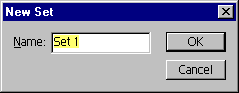
D. Create New Set
Click this push button to create a new action set. A dialog box will prompt you for the gear up'due south proper name. This button is equivalent to choosing the New Set command from the Deportment palette bill of fare.
E. Create New Action
Click this button to add a new activity to the selected set. A dialog volition prompt yous for the activity's proper name, associated gear up, keyboard shortcut and Button Mode colour. This push is equivalent to choosing the New Activeness command from the Deportment palette menu.
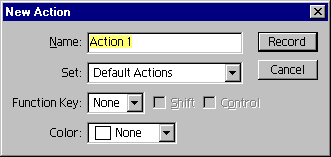
Note: Alt-click the New Activity button to skip the dialog and simply accept the default name (and settings) for the new action. Drag-and-drop an existing action onto the New Activity push button to duplicate it. This is equivalent to choosing Duplicate from the Deportment palette menu
F. Delete
Deletes the selected gear up, action or command. A dialog box will appear, allowing you to ostend the functioning. Alternatively, you may admission the Delete command from the Actions palette menu.
Annotation: Alt-click the Delete push to delete the selected item without confirmation. This is equivalent to dragging the desired item onto the Delete button. Delete operations performed in the Actions palette are non added to the History, nor are they available via the Edit » Disengage command. However, you may undo / redo (just) the last delete operation by pressing Ctrl+Z.
M. Activity Set
Sets behave similarly to folders in that they let you lot to organize your actions. You may have as many every bit 24 actions within each set; and you may have equally many sets equally you like. Double-click on a set (or choose Set Options from the Actions palette card) to change its proper name.
H. Action
An action is basically a Photoshop macro containing one or more pre-recorded commands and/or operations that can exist replayed on an epitome (or sequence) by clicking the Play button or past pressing a predefined keyboard shortcut. Playing an activity executes the series of commands contained within it. Deportment can only exist created within a set (i.e. they cannot be in the Actions palette outside of a fix). Double-click on an activity (or choose Action Options from the Actions palette menu) to change its name, keyboard shortcut and Button Style color.
I. Activity Step / Command
Quite only, action steps are pre-recorded Photoshop commands. Deportment are comprised of one or more activeness steps.
Note: Alt-elevate-and-drop an existing action pace to indistinguishable it. This is equivalent to choosing Indistinguishable from the Actions palette menu.
J. Deportment Step / Command Details
Expanding an action step (by clicking on its associated triangular icon) reveals the details (or values) that were set for the command at the fourth dimension it was recorded.
Note: You may change the parameters for a command by double-clicking on its associated action step (or by choosing Tape Again from the Actions palette menu). If available, the command dialog will appear, allowing y'all to enter new values. Choose OK to apply the new settings or Abolish to get out the original settings.
1000. Dialog Checkbox
This checkbox is used to enable (or disable) a control'southward dialog box – the checkbox is only available for commands that have an associated dialog box. If enabled, a minor dialog icon volition appear to indicate that Photoshop should suspension the action at the designated step to prompt the user for the desired values. The default is to not display a dialog box (indicated by an empty checkbox), but instead, to use the values that were recorded for the command when the action was created.
Annotation: Enabling (or disabling) the dialog checkbox for a gear up turns on (or off) all dialogs for all actions inside the fix. Similarly, enabling (or disabling) the dialog checkbox for an action turns on (or off) all dialogs for all applicable commands inside the specified activeness (but does not bear upon any other actions within the current set). A cherry dialog icon indicates that i or more than (but non all) dialogs have been enabled inside an action (or set). A grey (or ghosted) dialog icon indicates i of two things: either the dialog box has been enabled, but the command, action or prepare has been excluded; or, the command was inserted, without values, via the Insert Menu Particular command (come across below). In the case of the latter, the user will be prompted for values when the action is executed.
Fifty. Include Checkbox
The include checkbox is used to turn action steps – or even unabridged deportment or sets – on or off. By default, all commands have a pocket-size checkmark icon, indicating that the commands are to exist included when an action is played. An empty checkbox indicates that the command has been disabled (or excluded), meaning that Photoshop volition skip over it when executing the activity.
Notation: Enabling (or disabling) the include checkbox for a fix turns on (or off) all steps for all deportment within the gear up. Similarly, enabling (or disabling) the include checkbox for an action turns on (or off) all steps within the specified action (but does not bear upon any other deportment within the electric current set). A ruby checkmark icon indicates that one or more (but not all) steps inside an action (or set up) have been disabled.
K. Actions Palette Card
In add-on to the many controls discussed above, the Actions palette menu (accessed by clicking the  button) also contains several commands that are very useful for creating and editing actions.
Dock to Palette Well
Quite only, this command stores (or "docks") the Actions palette in the Palette Well (on the right side of the Options palette). This is equivalent to manually dragging the Actions palette into the Palette Well.
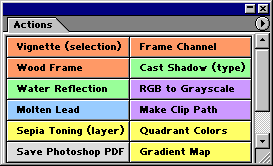
Push Mode
By default the Actions palette appears in List View Style. Button Mode turns each activeness into a button displaying the name, color and keyboard shortcut assigned to it in the Activity Options dialog. Simply click a button to play its respective action. Despite how easy Push Mode is to use, its usefulness is limited considering y'all cannot create, edit or modify deportment in any way while in this mode.
This command allows you to insert the selected menu detail into the current activeness. Inserted items appear beneath the agile action step. This command is available regardless of whether or non you are in record mode.
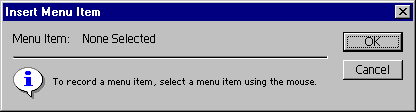
Two key uses for this control are: to insert commands that may otherwise be unavailable (or inaccessible) while in record mode (such equally showing or hiding palettes); or, to insert a command without values (so as to prompt the user for input when the activeness is played).
Insert Stop
Despite its name, a cease does not actually cease an activeness; information technology simply pauses the action to display a user-defined message box (of up to 200 characters). Typical uses for a stop include: providing instructions or copyright and/or version information to other users; or, to allow the user to perform manual tasks such equally painting, or inserting text, prior to resuming the activity. Past default, Terminate dialogs always incorporate a Stop push button: nonetheless, an optional Go along push button may also exist included.
Insert Path
This command is only available when a path (or shape) is selected. Use it to insert the selected path into the selected action (below the active stride) as a series of ballast and handle coordinates.
Tip: Set your ruler units to percent before using this control. This will ensure that the path is sized and positioned relative to the canvas size. Otherwise, the path may appear too large, or completely outside the canvas boundaries.
Set / Action Options
Employ this control to rename an action (or set) or to alter its function cardinal or Button Mode color. You may likewise double-click on an action (or set) to access the Options dialog box.
Note: Assigning a keyboard shortcut (or hotkey) allows you to speedily execute an action by pressing the assigned fundamental(s) on the keyboard. Yous may even wish to assign a keyboard shortcut to frequently used commands that do non already have an associated "hotkey" (such as Image » Crop, or Edit » Stroke).
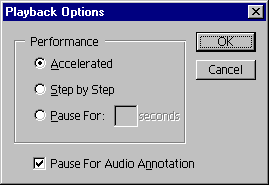
Playback Options
This command allows y'all to set the playback speed for actions. Accelerated plays actions as fast as possible (which is desirable for most circumstances), Step past Stride allows the screen to refresh betwixt commands (useful for debugging), and Pause For pauses between commands for the defined number of seconds (betwixt ane and 60). You may also toggle the Wait For Audio Note pick on or off.
Clear All Deportment
Every bit the name implies, this command removes all actions (and sets) from the Deportment palette.
Note: Although you cannot disengage this operation via the History palette or the Edit » Disengage command, you tin undo (or redo) the last performance (merely) past pressing Ctrl+Z.
Reset Actions
This control removes all actions from the palette and replaces them with the default set.
Note: Selecting this control volition event in a alarm message that allows you to accept the replacement, cancel it, or append the default prepare to the existing set(southward). Hold down the Alt key when choosing this control to skip the warning. This command can be undone by pressing Ctrl+Z.
Load Actions
Use this command to load an existing activeness set. Also note that you tin can quickly load deportment by choosing them (past name) from the bottom of the palette carte du jour.
Note: In order for an action to appear in the Deportment palette menu, information technology must be saved in the Photoshop seven.0\Presets\Photoshop Actions\ folder (or subfolder).
Replace Deportment
Replaces all actions (and sets) in the Actions palette with the selected set.
Save Actions
Although the contents of the Actions palette are remembered from one session to another, they are non really saved until you lot salvage them using this command. In fact, yous cannot use either of the above commands (Load Deportment and Replace Actions) for a set until it has first been saved. As well, you cannot save private deportment, but sets. If you want to save a single action, information technology must be placed into its own set. Save your actions in the Photoshop seven.0\Presets\Photoshop Deportment\ folder (or subfolder).
Creating simple actions===>
Photoshop Actions Folder Read Only Cannot Change
Source: https://www.geneseo.edu/~saa/tutorials/dec_9/index.htm
0 Response to "Photoshop Actions Folder Read Only Cannot Change"
Post a Comment